





Why At-Home Recovery Is Now a Performance Advantage
Elite athletes have had access to dedicated recovery suites for decades: cold plunge pools, infrared saunas, percussion therapy stations. In 2026, you can build a comparable setup in your living room for a fraction of the cost.
This is not a niche trend. The home rehabilitation products and services market is valued at USD 114.18 billion in 2026, growing at a 6.7% CAGR, according to Research and Markets. Homecare rehabilitation settings are growing at an 11.82% CAGR, outpacing hospital settings, per Mordor Intelligence. Recovery is moving home by design, not by accident.
Here is the reframe most people miss: recovery is not something you do after an injury. It is a daily non-negotiable that separates high performers from everyone else. If you sit at a desk eight hours a day, chronic tension and posture breakdown are actively working against you. Daily intervention is essential.
Step 1: Fix the Foundation with Posture and Ergonomic Support
Before you buy a single recovery gadget, look at how you sit. Desk work creates chronic muscle imbalances in the neck, shoulders, and lower back. These imbalances generate persistent tension that undermines every other recovery tool you use.
Most people try to foam roll or massage their way out of pain that originates from eight hours of poor spinal alignment. That treats the symptom while feeding the cause. Orthopedic supports (posture correctors, ergonomic cushions, supportive insoles) are the unglamorous but essential first layer of any at-home recovery stack.
Think of it as recovery prevention. The goal is to reduce the tension load before it accumulates, rather than chasing it after the fact. A posture corrector worn during your first work hour costs nothing in time and reduces the muscular debt your body carries into the evening.
Practical first step: audit your sitting posture and workstation setup before investing in any active recovery device. Adjust your monitor height, check your chair support, and notice where you hold tension. This foundation makes everything that follows more effective.
Step 2: Active Recovery Devices, Your Core Stack
Once your posture foundation is set, three tools form the core of an effective at-home recovery routine: a foam roller, a percussion massager, and a TENS unit. Each serves a distinct purpose.
Foam rollers are your entry point for myofascial release. A randomized trial found foam rolling produced a 22.8% pain reduction at 24 hours, 39.2% at 48 hours, and 59.7% at 72 hours post-exercise, according to TheGrantedSolutions. Those are real, measurable results from a tool that costs under $30.
Percussion massagers target deeper muscle tissue with rapid, concentrated pressure. North America holds 37.05% of massage gun market revenue, confirming these are mainstream tools, not luxury items. They are especially effective for large muscle groups like quads, glutes, and upper back.
TENS units deliver electrical stimulation for pain relief without medication. They are part of the therapy equipment segment worth USD 10.94 billion in 2025, according to DataIntelo. Portable units now deliver clinical-grade relief at home for under $50.
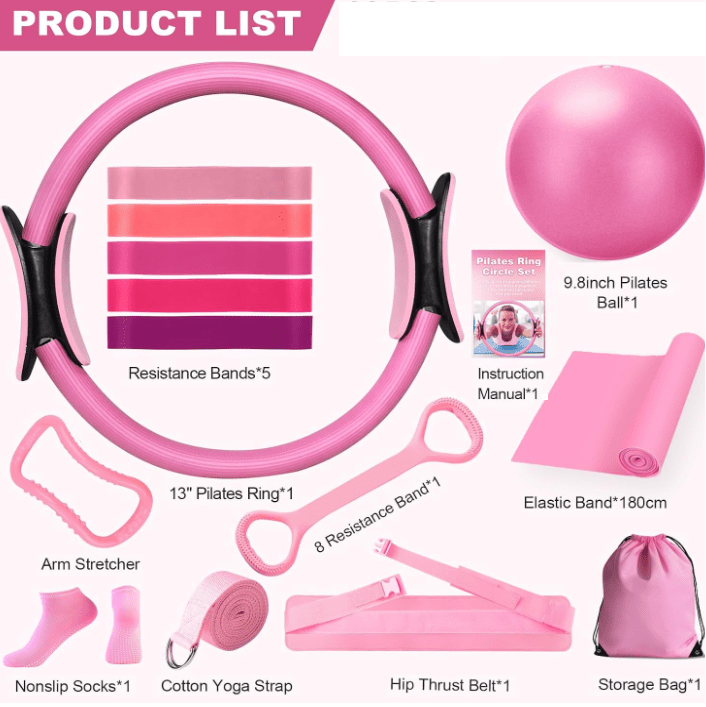
Budget-conscious approach: start with a foam roller and a TENS unit for under $100 combined, then scale to percussion and heat therapy over time. If you want to add mobility and flexibility work without a large upfront investment, the 13-Piece Yoga & Pilates Set pairs resistance bands and a yoga ring naturally with foam rolling sessions. No massive upfront spend required.
Step 3: Heat and Light Therapy to Accelerate Healing at the Cellular Level
This is where your recovery stack moves from good to genuinely powerful.
Red light therapy, also called photobiomodulation, boosts ATP production in mitochondria — the energy currency your cells use to repair tissue. Studies show muscle function recovered 30% faster with photobiomodulation protocols, according to PeakSaunas. This is measurable at the cellular level.
Heat therapy delivers its own set of benefits. A study of over 1,600 people found that more frequent sauna use was associated with reduced risk of cardiovascular events, along with increased growth hormone production and muscle relaxation, as reported by Kintinu Telerehab. Targeted heat devices like therapy belts for your lower back and shoulders are far more accessible than a full-body sauna, and most competing content overlooks them entirely.
Red light therapy also improves sleep quality scores by 20 to 40% across multiple human trials. A 2025 systematic review published in Frontiers in Behavioral Neuroscience confirmed that photobiomodulation can meaningfully enhance sleep quality and wakefulness regulation, as noted by MitoRed Light. That bridges physical recovery and sleep optimization in a single modality.
Practical sequence: use heat therapy for 15 to 20 minutes post-activity to relax muscle tissue, then apply red light therapy in the evening to reduce inflammation and prime your body for sleep. By 2034, an estimated 67% of home rehabilitation devices will incorporate digital monitoring. The devices you invest in today put you on the early edge of that shift.
Step 4: Close the Loop with Sleep Tracking and Evening Wind-Down
Recovery is only complete when sleep is optimized. You can run the best daytime recovery protocol available, but if your sleep is fragmented or shallow, you are leaving results on the table.
Nearly 48% of adults used a sleep tracking device in 2025, according to the AASM Sleep Prioritization Survey. Smartwatches and smartphone apps are the most common entry points. For higher accuracy, the Oura Ring Gen 3 achieved 76 to 79.5% four-stage sleep staging sensitivity in a Brigham and Women's Hospital study, the highest of any consumer device tested against clinical polysomnography.
Wearable monitoring devices do more than track sleep. They improve exercise form by 45 to 58% and reduce re-injury risk by 31 to 39% compared to non-monitored programs. Use your HRV and recovery scores as daily decision tools: if your HRV is low, prioritize passive recovery (heat, light therapy); if it is high, lean into active recovery (foam rolling, mobility work). Data-driven recovery outperforms guesswork every time.
Evening wind-down protocol: red light therapy session, sleep mask on, smart tracker active. Treat this sequence as a unified routine. Sleep is a recovery tool, not an afterthought. Monitoring devices account for 19.3% of the home rehabilitation market with the highest projected CAGR of 7.6% through 2034. This segment is accelerating fast.
Your Weekly At-Home Recovery Schedule
A routine only works if it is repeatable. Here is a concrete structure you can start this week.
Morning Protocol (10 to 15 minutes)
- Wear your posture corrector during the first work hour
- Foam roll major muscle groups: upper back, quads, calves (5 minutes)
- Light resistance band mobility work: shoulder dislocates, hip circles, ankle rotations (5 minutes)
Evening Protocol (20 to 30 minutes)
- Targeted heat therapy on primary tension areas: lower back, neck, shoulders (15 to 20 minutes)
- Red light therapy session (10 to 15 minutes, can overlap with heat therapy wind-down)
- Sleep tracker activated before bed; sleep mask on
Weekly Structure
- Daily: active recovery tools (foam roller, TENS as needed)
- 4 to 5x per week: heat and light therapy sessions
- 2 to 3x per week: full mobility session using yoga and pilates accessories
Consistency beats intensity in recovery. A repeatable 20-minute daily routine will outperform an occasional 90-minute session every time. Build this stack incrementally: start with two devices and add layers as your budget allows.
Start Building Your Recovery Room Today
Gym chains like Equinox charge premium memberships for access to recovery rooms. Your at-home stack delivers comparable results at a fraction of the ongoing cost.
The framework is straightforward: posture foundation → active recovery stack → heat and light therapy → sleep optimization and tracking. Four layers, each reinforcing the next.
The home rehabilitation market is growing because the results are real. According to a June 2026 Vivalink survey, 72% of patients say they are comfortable recovering at home instead of in a hospital setting. The preference is clear, and the technology has caught up.
Identify which layer of the routine you are missing and start there. One device. One habit. Compounded over time. Recovery is not passive rest. It is engineered performance, and it starts at home.
Sources
- Research and Markets – Home Rehabilitation Products and Services Market Report 2026
- Mordor Intelligence – Rehabilitation Equipment Market Size & Share Analysis (2026)
- TheGrantedSolutions – Muscle Recovery Tools That Actually Work in 2026
- DataIntelo – Home Rehabilitation Market Size, Share & Forecast Report 2025–2034
- PeakSaunas – Red Light Therapy Benefits: Complete Evidence-Based Guide 2025
- Express Press Release – Therapy Devices Market Analysis (May 2026)
- MitoRed Light – Red Light Therapy and Sleep: What the Research Actually Shows
- AASM – Sleep Prioritization Survey 2025
- MotionSync Health – Best Wearable for Sleep Tracking in 2026
- Vivalink / Outsource Accelerator – 72% of Acute Patients Are Ready for Home-Based RPM Recovery (June 2026)